


Best-Selling Cancer Drugs 2025: Top 10 by Revenue
Updated: 4 days ago
BEST SELLING CANCER DRUGS | TOP ONCOLOGY DRUGS | 2025
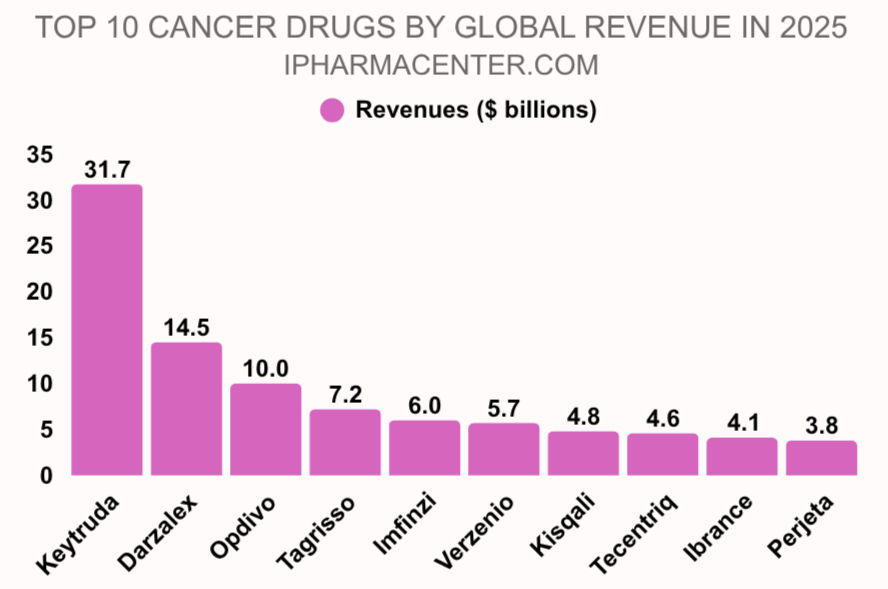
BEST SELLING CANCER DRUGS 2025
Rank | Brand | Company | Indications | Revenues $ billion |
1 | Keytruda | Merck | Melanoma, NSCLC, HNSCC, Hodgkin Lymphoma, Urothelial Cancer, RCC, HCC and several other cancers | $31.7 |
2 | Darzalex | Johnson and Johnson | Multiple myeloma | $14.5 |
3 | Opdivo | Bristol Myers Squibb | Melanoma, NSCLC, Hodgkin Lymphoma, Urothelial Cancer, RCC, HCC and several other cancers | $10.0 |
4 | Tagrisso | AstraZeneca | EGFR positive NSCLC | $7.2 |
5 | Imfinzi | AstraZeneca | NSCLC, SCLC, locally advanced or metastatic biliary tract cancers, gastric/gastroesophageal junction cancer, HCC, bladder cancer and dMMR endometrial cancer | $6.0 |
6 | Verzenio | Eli Lilly | HR+/HER2-negative breast cancer | $5.7 |
7 | Kisqali | Novartis | HR+/HER2-negative breast cancer | $4.8 |
8 | Tecentriq | Roche | UC, NSCLC, SCLC, triple-negative breast cancer, HCC | $4.6 |
9 | Ibrance | Pfizer | HR+/HER2-negative breast cancer | $4.1 |
10 | Perjeta | Roche | Metastatic breast cancer, early-stage breast cancer | $3.8 |
In 2025, global oncology revenues continue to be dominated by immune checkpoint inhibitors and targeted therapies, with Merck’s PD‑1 inhibitor Keytruda far ahead of the field. The top 10 cancer drugs by sales span solid tumors and hematologic malignancies and increasingly anchor multi‑drug regimens and earlier‑line treatment strategies.
Keytruda (pembrolizumab) - $31.7 billion
Mechanism of action: PD‑1 checkpoint inhibitor
Merck’s mega-blockbuster immunotherapy pembrolizumab (Keytruda) firmly held its crown as the world's top-selling prescription drug in 2025. Generating an estimated $31.7 billion in global sales, the anti-PD-1 checkpoint inhibitor logged roughly 7% year-over-year growth, accounting for a massive share of Merck's overall pharmaceutical revenue.
Also read: Top 10 Pharma Companies by Revenue in 2025
Why It Dominates the Market
Keytruda's commercial dominance is driven by an unprecedented regulatory footprint that spans more than 20 indications across both solid tumors and hematological malignancies, including advanced melanoma, non-small cell lung cancer (NSCLC), and renal cell carcinoma.
Rather than relying purely on late-stage, metastatic treatment cycles, Merck has aggressively pushed Keytruda into earlier lines of defense. The drug's target patient pool expanded significantly due to rapid adoption in perioperative (neoadjuvant and adjuvant) settings, where it is administered both as a standalone monotherapy and in synergy with standard chemoradiotherapy.
Also read: AIFA Innovative Drugs April 2026: Opdivo, Yervoy, Rybrevant, Carvykti Lead New Additions
While Keytruda remains unmatched at the top of the oncology market, all eyes are on Merck’s pipeline strategies as the industry prepares for the drug's looming 2028 patent expiration.
Darzalex (daratumumab) - $14.5 billion
Mechanism of action: Anti‑CD38 monoclonal antibody
Darzalex (daratumumab) is a first in class monoclonal antibody directed against the CD38 antigen and is used in the treatment of multiple myeloma across a wide range of settings. It is approved for both newly diagnosed multiple myeloma and relapsed or refractory disease, in patients who are eligible for autologous stem cell transplant and in those who are not candidates for transplant.
What is driving Darzalex's revenues?
Daratumumab based regimens can be given as monotherapy or in combination with standard myeloma backbones that include agents such as bortezomib, lenalidomide, carfilzomib and pomalidomide, and several of these combinations are listed as preferred options in NCCN Clinical Practice Guidelines for transplant eligible and transplant ineligible patients as well as in early relapse after one to three prior lines of therapy (for example DRd, DVd, DKd and DPd).
Also read: Top 10 U.S. healthcare companies by 2026 revenue
In addition to its clinical use, patients prescribed Darzalex may be able to access company sponsored patient support services such as the J&J withMe program, which is designed to offer individualized assistance during treatment, including information, practical resources and help navigating coverage or financial support options where available.
Tagrisso (osimertinib) - $7.2 billion
Mechanism of action: EGFR tyrosine kinase inhibitor
AstraZeneca’s EGFR inhibitor osimertinib (Tagrisso) continued its strong commercial momentum in 2025, generating $7.2 billion in revenue, reflecting a 10% increase at constant exchange rates.
What is driving Tagrisso's revenues?
Tagrisso is being positioned as the core EGFR‑mutated NSCLC therapy across early, first‑line, and later‑line disease. ADAURA, FLAURA, and AURA trials support its use from adjuvant to metastatic settings, while LAURA’s positive ASCO 2024 readout backs a new standard in unresectable stage III disease.
Also read: China’s Biotech Momentum Grows as Pfizer Signs Multi-Billion Dollar Deal with Innovent
The pipeline now pushes earlier and broader use with NeoADAURA and ADAURA2, alongside combination strategies such as TROPION‑Lung14/15 and Dato‑DXd, plus Phase III SAVANNAH/SAFFRON to tackle resistance. Overall, AstraZeneca’s strategy is to keep Tagrisso as the backbone TKI and build “TKI‑plus” ADC combinations on top to extend benefit and sustain growth.
Imfinzi (durvalumab) - $6.0 billion
Mechanism of action: PD‑L1 checkpoint inhibitor
Imfinzi is being built out as a broad immuno‑oncology franchise, with clinical and commercial presence in NSCLC, SCLC, hepatocellular carcinoma, and biliary tract cancer.
Imfinzi is a PD‑L1 inhibitor with approvals spanning multiple solid tumours, reflecting its expanding role across indications.
What is driving Imfinzi's revenues?
In NSCLC, AstraZeneca is moving beyond the PACIFIC maintenance setting by pushing Imfinzi into earlier-stage disease through programs such as AEGEAN and PACIFIC‑4.
Combination strategies with the ADC Dato‑DXd, both in NSCLC and across several breast cancer studies, are emerging as a key growth lever, positioning Imfinzi as a backbone IO partner for next‑generation ADC-based regimens.
Verzenio (abemaciclib) - $5.7 billion
Mechanism of action: CDK4/6 inhibitor
Verzenio is an oral small‑molecule inhibitor of cyclin‑dependent kinases 4 and 6, which regulate cell‑cycle progression from G1 to S phase. It is approved for hormone receptor‑positive, HER2‑negative breast cancer in both metastatic and early‑stage high‑risk settings, typically combined with endocrine therapy (such as aromatase inhibitors or fulvestrant) to delay progression and recurrence.
Also read: EULAR Annual Meeting in London, UK | 2026
Kisqali (ribociclib) - $4.8 billion
Kisqali is another selective CDK4/6 inhibitor that halts cell‑cycle progression in Rb‑proficient tumor cells. Its label covers HR‑positive, HER2‑negative advanced or metastatic breast cancer in combination with an aromatase inhibitor or fulvestrant in pre‑/perimenopausal and postmenopausal patients, with growing use in earlier‑line metastatic settings following strong overall‑survival data.
8. Tecentriq (atezolizumab) - $4.6 billion
Mechanism of action: PD‑L1 checkpoint inhibitor
Tecentriq is a humanized IgG1 monoclonal antibody targeting PD‑L1, blocking its interactions with PD‑1 and B7.1 to restore antitumor T‑cell responses. It is approved for extensive‑stage small cell lung cancer, certain NSCLC settings, hepatocellular carcinoma, triple‑negative breast cancer, and urothelial carcinoma, often in combination with chemotherapy or targeted agents.
Also read: American Society of Clinical Oncology (ASCO) Annual Meeting | Chicago | 2026
Ibrance (palbociclib) - $4.1 billion
Mechanism of action: CDK4/6 inhibitor
Ibrance is a first‑in‑class oral CDK4/6 inhibitor that selectively inhibits cyclin‑D–dependent CDK4 and CDK6, leading to G1 cell‑cycle arrest. It is indicated for HR‑positive, HER2‑negative advanced or metastatic breast cancer in combination with aromatase inhibitors or fulvestrant, primarily in first‑line or subsequent‑line settings for postmenopausal women and men.
Also read: Top 10 Pharma Companies by Revenue in 2025
10. Perjeta (pertuzumab) - $3.8 billion
Mechanism of action: HER2‑targeted monoclonal antibody
Perjeta is a humanized monoclonal antibody that binds a different epitope of the HER2 receptor than trastuzumab, blocking ligand‑dependent HER2 dimerization (especially HER2‑HER3), which is critical for downstream signaling. It is approved, in combination with trastuzumab and chemotherapy, for HER2‑positive metastatic breast cancer and for neoadjuvant and adjuvant treatment of early‑stage HER2‑positive breast cancer, forming a backbone of dual HER2 blockade.
FREQUENTLY ASKED QUESTIONS
FAQ 1: What are the top 10 best‑selling cancer drugs in 2025 and their global revenues?
In 2025, the top 10 oncology drugs by estimated worldwide sales were:
Keytruda (Merck) at over 31 billion dollars, Darzalex (Johnson & Johnson) above 13 billion dollars, and Opdivo (Bristol Myers Squibb) with more than 9 billion dollars in revenue.
Tagrisso (AstraZeneca) generated over 7 billion dollars, Imfinzi (AstraZeneca) around 6 billion dollars, Verzenio (Eli Lilly) about 5 billion dollars, and Kisqali (Novartis) approximately 4.5 billion dollars.
Tecentriq (Roche) delivered more than 4 billion dollars, while Ibrance (Pfizer) and Perjeta (Roche) rounded out the list with roughly 3.8 and 3.5 billion dollars respectively, underscoring the dominance of immunotherapy and targeted agents in the 2025 cancer drug market.
FAQ 2: Why Opdivo lost commercial ground to Keytruda?
Although Opdivo launched early and quickly built indications, it ultimately fell behind Keytruda for two main reasons.
First, in first line NSCLC, Merck ran KEYNOTE 024 in a biomarker selected population with very high PD L1 expression, showing a strong survival benefit and securing a clean, early label, while Bristol Myers Squibb’s used a lower PD L1 cutoff in a broader group and failed to meet its primary endpoint, which delayed Opdivo in this critical market.
Second, over time Keytruda expanded into more tumor types, earlier disease stages and tissue agnostic indications, giving it a broader label and a larger treatable population than Opdivo, which is one of the key reasons Keytruda has pulled ahead in total revenue.
Also read: China NMPA Approves Pfizer’s Matazisimab (You Ruiting) for Routine Prophylaxis in Hemophilia Patients with Inhibitors


Comments